Wilhelm Klink (1874–1952). Sculptor, painter and local historian in Horb am Neckar
Wilhelm Klink was a sculptor, painter, draughtsman, restorer and local historian in Horb am Neckar in southern Germany. He is regarded as the last significant representative of the Horb school of sculpture. Today he is known above all for the Horber Bilderbuch, the painted facade of the town hall and guard house on the upper market square.
19 January 1874, Untertalheim · 2 April 1952, Horb am Neckar
Wilhelm Klink is the grandfather of the sculptor Albrecht Klink. His artistic work comprises religious sculpture and painting, drawings, historical reconstructions, models and facade paintings. He worked for more than five decades. At the same time he spent his whole life studying the history of his home town of Horb and its surroundings.
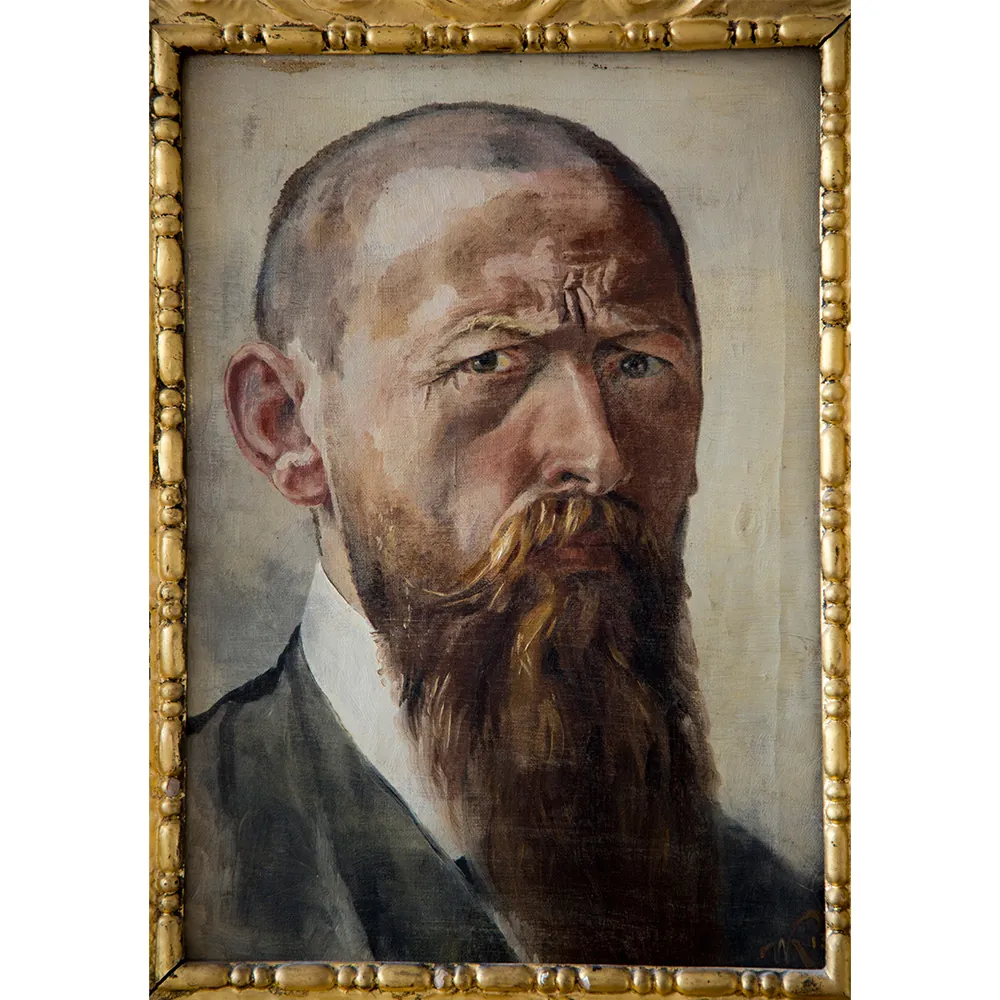
His importance goes beyond the town hall facade. Klink left many traces in the townscape of Horb and in the churches of the region. He documented historic buildings, made reconstruction drawings, studied medieval works of art and campaigned for their preservation. In 1917 he discovered the long-lost Horb Madonna in the Steinhaus.
Origins, apprenticeship and training
Wilhelm Klink was born on 19 January 1874 in Untertalheim, today part of the town of Horb am Neckar. His training began at about the age of sixteen. He later said of it that he had never really finished it.
In 1889 he was apprenticed to the sculptor Vollmer in Rottenburg, where he stayed only a year. He then moved to Horb, to the workshop of Peter Paul Hausch. This workshop stood in the tradition of the Horb school of sculpture and specialised in church art and church furnishings. The direction of Johann Nepomuk Meintel, continued there, suited his artistic intentions better.
In 1892 Klink passed his journeyman's examination with distinction. He then attended the School of Applied Arts in Nuremberg, where he was taught by the professors Schwabe, Rößner and Fleischmann, the last a well-known scholar of Veit Stoss. The Nuremberg years added a further artistic training to his craft skills.
The term Horb school of sculpture does not denote an art academy in today's sense. It means a workshop and training tradition that lasted several generations and was bound up above all with church art. Among its important names are Johann Nepomuk Meintel, Peter Paul Hausch and finally Wilhelm Klink. What distinguished this training was the combination of different skills. Sculptors, painters, draughtsmen, ornamental workers and restorers worked closely together. That versatility reappears later in Klink's own life's work.
His own studio in Horb
After his training Wilhelm Klink worked as an independent artist in Horb am Neckar. Many works came out of his studio, a large part of them connected with churches and religious art. Klink was not tied to a single technique. He worked as a sculptor, painter, draughtsman, graphic artist, restorer, designer and as a reconstructor of historic buildings and works of art. It is precisely this combination that makes his work interesting today.
In 1904 he married Sophie Bareis. Several children came from the marriage, among them Josef Klink, who later wrote the guide Alt-Horb, a historical tour of the town and drew explicitly on his father's notes for it.
The Horber Bilderbuch
Wilhelm Klink's best-known work stands in the middle of the historic centre of Horb am Neckar: the painting of the town hall and guard house on the upper market square, known today as the Horber Bilderbuch, the Horb picture book.
On 2 July 1925 the Horb town council resolved to renew the exteriors of the town hall and guard house. At the same time it approved the painting of the facades with scenes from the history of Horb and portraits of important figures, after designs by the painter Wilhelm Klink. The budget was 2,500 Reichsmark. Klink was 51 years old at the time.
Because the town dropped the planned plastering work to save money, Klink had to apply his painting directly onto the existing old render after three coats of primer. He used Keim mineral paints. Work began in 1925, and the figure and coat-of-arms friezes were completed in August 1927.
Wilhelm Klink thus turned the facades into a kind of public history book of the town. The paintings show historic figures, coats of arms and scenes from the history of Horb, among them Dietrich Gutermann, said to have founded the Hospital of the Holy Spirit in 1352, Countess Ita von Toggenburg and Count Rudolf the Last of Hohenberg. The Horb cultural and museum society calls this facade painting one of the outstanding independent achievements in painting by the last representative of the Horb school of sculpture.
This is characteristic of Wilhelm Klink's whole way of thinking: history should not only be preserved in books, it should stay visible and understandable. In 2027 the Horber Bilderbuch will be a hundred years old.
The local historian
Alongside his work as an artist, Wilhelm Klink developed an intense passion for the history of his home region. He tracked down historic traces, documented buildings and reconstructed old views. He worked among other things on the historic town gates of Horb, on castles such as the moated castle of Hornau, Hohenberg castle and Herrenberg castle, on historic views of the town, on medieval works of art and on old fountains and buildings.
In this Klink combined his artistic ability with historical research. Where written sources alone were not enough, he tried to arrive at a picture of the past from old illustrations, building forms and surviving traces. Many of these drawings have an added value today because they show buildings or conditions that were later altered or have disappeared altogether. Part of his drawings is held by the Horb town museum.
Wilhelm Klink chaired the antiquarian society, founded the first museum in Horb and built up its collection of antiquities. He was also active in the Sülchgau antiquarian society, which researches the history of the counts of Hohenberg.
From today's point of view his work can be understood as an early form of active conservation. It should not, however, be equated with today's standards. The restoration methods of his time differed considerably from current principles. His achievement lies in recognising historic works of art and buildings as worth protecting at all, and in campaigning for their preservation.
The rediscovery of the Horb Madonna
Wilhelm Klink's best-known discovery is the Horb Madonna. In 1917 he found the long-lost late medieval figure in the Steinhaus in Horb. It had broken into many pieces and lay hidden under a stack of wood. Klink recognised its art-historical importance and pressed for its restoration.
The Madonna is attributed to the so-called Master of the Kreuzwinkel and dated to the early fifteenth century. The restoration was carried out in a workshop in Ulm and completed in the 1930s. The crown it wears today was newly made in the course of that restoration.
Klink's discovery is a striking example of how his work as an artist and his work as a local historian ran into one another.
Religious art and work in the churches of the region
A large part of Wilhelm Klink's artistic work was made in the field of Christian art. His training in the Hausch workshop had made him familiar with the tradition of church sculpture. He created and worked on sculptures, altars, altarpieces, wall and ceiling paintings, religious images, Christmas cribs and restorations of historic works of art.
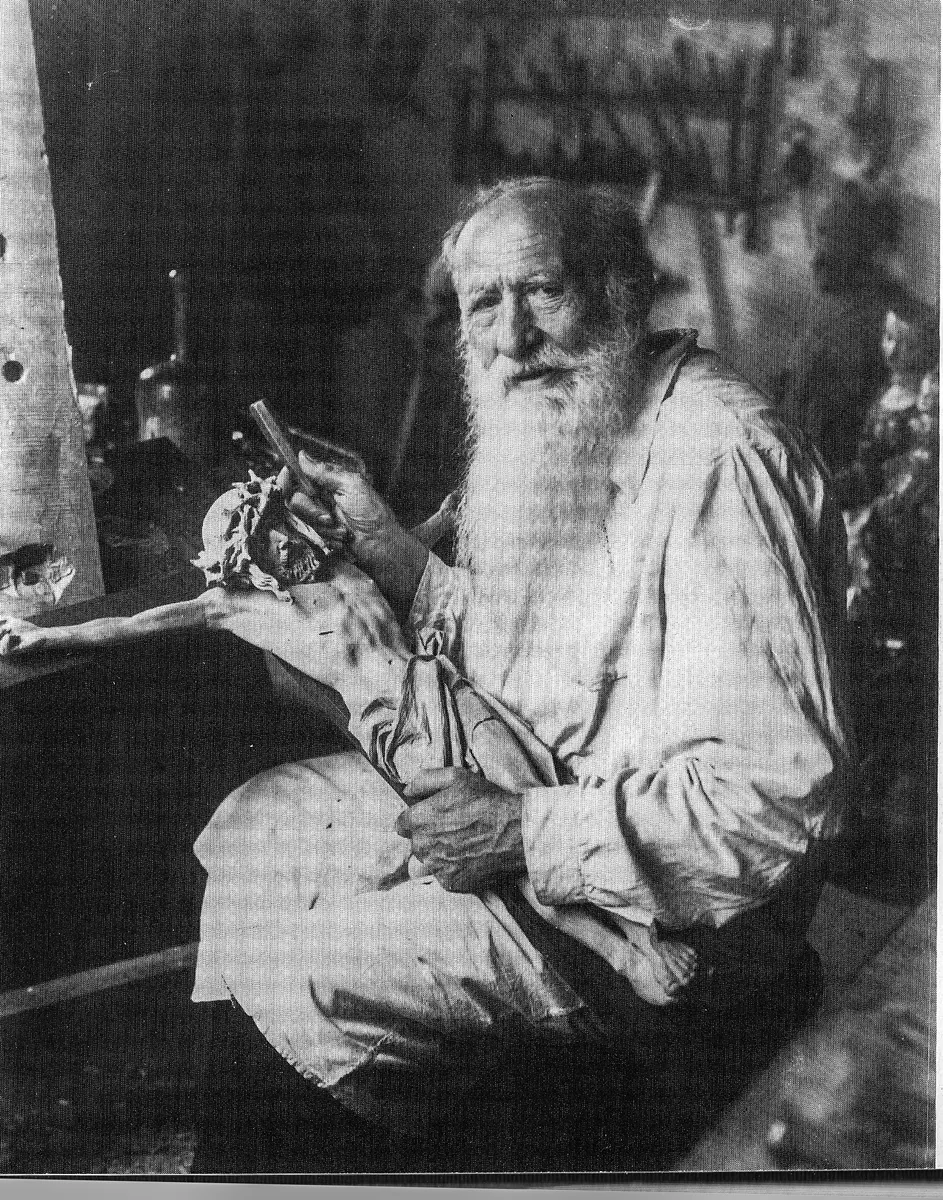
In his birthplace Untertalheim, works recall the artist born there. In the church of St Michael and St Laurence the Fourteen Holy Helpers and a Madonna of Mercy are his.
In the Ottilien chapel near Horb hangs his painting Dreimal wunderbare Mutter, the Thrice Admirable Mother, of 1935. It is connected with the Schoenstatt movement. In the lower part of the altarpiece Klink established a link between Schoenstatt and the town of Horb. The work was originally kept in the collegiate church.
In Grünmettstetten he painted a ceiling picture of the Adoration of the Magi. In 1924 he made a war memorial altar in the Marienkirche in Altheim. In the Church of the Holy Cross in Rottweil he designed two Nativity scenes in 1949 and 1950. Notably, he placed the biblical story in a regional setting there: instead of a traditional stable he used the ruin of a gothic chapel and brought the silhouette of the imperial city of Rottweil into the scene.
The Herrenberg church model of 1929
An unusual example of Klink's historical reconstruction work is the model of the Herrenberg collegiate church of 1929. It shows the church with its historic twin towers. These towers were taken down after lightning struck in 1749, and the church has carried its well-known dome ever since. An engraving by Matthäus Merian had preserved the image of the original twin towers and gave the Herrenberg town fathers the idea for the model.
It was made for the seven hundredth anniversary of the town and was carried through the streets in the procession by four children on a kind of sedan chair. The idea of historic building models had been taken up in Horb earlier, and Wilhelm Klink is named as the person who started it. The model was later rediscovered and restored with donations from the townspeople.
The Horber Kropfer
A less well-known side of his work concerns the Horb carnival. Wilhelm Klink took part in it himself as a young man, though he never carved wooden masks. Only at the end of the 1940s did the Horb carnival guild set about creating a first character of its own, the Horber Kropfer. Wilhelm Klink made the designs for it. The wooden mask itself was carved in the early 1950s by Georg Bergmann. Here too it is clear that Klink remained bound up with the cultural life of his home town into his last years.
The house on the Aischbach
An important personal place in Klink's life was the house on the Aischbach in Neckarstrasse in Horb. Klink acquired the historic building and set up his studio there. The house is today itself part of the history of the town. The connection with Wilhelm Klink is visible on the facade, where a painting of the Trinity by him can be seen. The house on the Aischbach is a vivid example of how Klink's personal life, his artistic work and the history of Horb come together.
Fridolin Knöpfle on Wilhelm Klink
The local historian Fridolin Knöpfle knew Wilhelm Klink personally. In his book Alt-Horb, published in 1982, he describes Klink's life, his training, his artistic work and his importance for local history. The passage that follows comes from that book. It is given here in German, in the original wording, with a translation.
Der letzte bedeutende und selbständige Vertreter der einst berühmten Horber Bildhauerschule
war Wilhelm Klink, der am 19. Januar 1874 in Untertalheim geboren wurde und am 2. April 1952
in Horb starb.
Er hat zeitlebens gewirkt aus der Schau des überzeugten Christen als Bildhauer, Zeichner,
Maler, als der nachhaltigste Heimatforscher und Geschichtsschreiber, auf dessen Forschungen
zwei Generationen Heimatkundler aufbauen konnten. Wilhelm Klink hat im Jahre 1917 im Steinhaus
die lange verschollene Horber Madonna entdeckt, die in vielen Einzelteilen unter Holzbeigen
vergraben worden war.
Schon ab dem 16. Lebensjahr widmete sich Wilhelm Klink der beruflichen Ausbildung, „die ich
eigentlich niemals ganz beendet habe“, berichtete er mir am Vorabend seines 75. Geburtstages.
Im Jahre 1889 trat Wilhelm Klink bei Bildhauer Vollmer in Rottenburg in die Lehre. Er blieb
dort aber nur ein Jahr, weil in der Zwischenzeit die Kunstrichtung Johann Nepomuk Meintels,
die im Atelier von Peter Paul Hausch in Horb fortgeführt, mehr seinen künstlerischen
Intensionen entsprach. 1892 legte Wilhelm Klink dann die Gesellenprüfung mit bestem Erfolg ab.
Danach besuchte er die Kunstgewerbeschule in Nürnberg, wo er von den Professoren Schwabe,
Rößner und Fleischmann (letzterer war ein bekannter Veit-Stoß-Forscher) unterrichtet wurde.
Nach einer gründlichen Ausbildung eröffnete Wilhelm Klink in Horb ein eigenes Atelier. Aus
diesem sind zahlreiche bedeutende Kunstwerke in alle Welt hinausgegangen. Einzelne zu nennen
wäre eine Herabsetzung anderer Werke.
Für Horb liegt die Bedeutung auf einem weiteren Gebiet: Wilhelm Klink hat alle wichtigen
Bauten rekonstruiert und neu gezeichnet, so dass wir heute noch wissen, wie die Stadttore
ausgesehen haben, die Burgen und Schlösser, wie z. B. das Wasserschloss Hornau, die Burg
Hohenberg und die Burg Herrenberg.
Wilhelm Klink hat unermüdlich geforscht, und zwar mit seinem „siebten Sinn“: er wurde fast
überall „fündig“ und konnte deshalb die arg verschüttete und besonders im Mittelalter arg
vernachlässigte Heimatgeschichte ein gutes Stück auf den Weg der Zukunft bringen.
Als ich kürzlich mit einigen Leuten, die über Horb in Büchern, in Filmen und im Fernsehen
berichten wollten, durch die Stadt gegangen bin, war ich selbst erstaunt, wieviel Spuren
Wilhelm Klink in Horb hinterlassen hat: Im Rathaus, im Heimathaus Hoher Giebel, an den Brunnen
der Stadt, in Liebfrauen und Heilig Kreuz, an seinem Wohnhaus in der Neckarstraße, in
unendlich vielen Aufzeichnungen. Wilhelm Klink ist und bleibt ein großer Künstler, einer der
größten Heimatpfleger und -forscher. Er war bescheiden in seiner Art, aber unerbittlich in
seiner Überzeugung. Selbst massive Drohungen im Dritten Reich konnten den Altmeister der
Horber Bildhauer nicht einschüchtern. Es war selbstverständlich, dass Wilhelm Klink dem
Altertumsverein vorstand, das erste Museum gründete, die Altertümer Sammlung in Horb — und
dass er aktiv war im Sülchgauer Altertumsverein, der die Geschichte der Hohenberger mit
Nachdruck erforscht.
Künstler, Forscher, Rufer und Bekenner war Wilhelm Klink, fürwahr sehr viel für einen
einzelnen Menschen. Die Welt bringt wenige Begnadete mit dieser Bandbreite hervor.
Fridolin Knöpfle: Alt-Horb. Geiger Verlag, Horb am Neckar 1982.
The passage in English
The last significant and independent representative of the once famous Horb school of sculpture was Wilhelm Klink, born on 19 January 1874 in Untertalheim and died on 2 April 1952 in Horb.
All his life he worked from the outlook of a convinced Christian, as a sculptor, draughtsman and painter, and as the most enduring local historian and chronicler, on whose research two generations of local historians were able to build. In 1917 Wilhelm Klink discovered in the Steinhaus the long-lost Horb Madonna, which had been buried in many separate pieces under stacks of firewood.
From the age of sixteen Wilhelm Klink devoted himself to his training, "which I never really finished at all", as he told me on the eve of his seventy-fifth birthday. In 1889 Wilhelm Klink was apprenticed to the sculptor Vollmer in Rottenburg. He stayed there only a year, because in the meantime the direction of Johann Nepomuk Meintel, continued in the studio of Peter Paul Hausch in Horb, corresponded more closely to his artistic intentions. In 1892 Wilhelm Klink then passed his journeyman's examination with the best result. He then attended the School of Applied Arts in Nuremberg, where he was taught by the professors Schwabe, Rößner and Fleischmann, the last of whom was a well-known scholar of Veit Stoss.
After a thorough training Wilhelm Klink opened his own studio in Horb. From it a great many important works of art have gone out into all the world. To name individual ones would be to belittle the others.
For Horb his importance lies in a further field: Wilhelm Klink reconstructed and redrew all the important buildings, so that we still know today what the town gates looked like, and the castles and manors, such as the moated castle of Hornau, Hohenberg castle and Herrenberg castle.
Wilhelm Klink researched tirelessly, and did so with his "seventh sense": he struck lucky almost everywhere, and was therefore able to carry the badly buried local history, so much neglected for the Middle Ages in particular, a good way forward.
When I recently walked through the town with some people who wanted to report on Horb in books, in films and on television, I was astonished myself at how many traces Wilhelm Klink has left in Horb: in the town hall, in the Hoher Giebel local museum, on the fountains of the town, in Liebfrauen and Heilig Kreuz, on his own house in the Neckarstraße, in endless numbers of notes. Wilhelm Klink is and remains a great artist, one of the greatest conservators and researchers of local history. He was modest in manner but unyielding in his convictions. Not even massive threats in the Third Reich could intimidate the old master of the Horb sculptors. It went without saying that Wilhelm Klink presided over the antiquarian society, founded the first museum, the collection of antiquities in Horb, and that he was active in the Sülchgau antiquarian society, which researches the history of the counts of Hohenberg with determination.
Artist, researcher, herald and witness was Wilhelm Klink, truly a great deal for one single person. The world produces few gifted people of such range.
Wilhelm Klink today
For his 150th birthday the Horb town museum devoted a large special exhibition to the artist in 2024, under the title Eine „Horber Bilderbuch“-Karriere: Wilhelm Klink (1874–1952). It ran from 21 April to 1 November 2024 and showed more than two hundred works from the museum's holdings and from private and church ownership.
In August 2026 Klink's life and the history of the town hall facade became the subject of a theatre project. Under the title Horber Bilderbuch, the Pina Bucci Teatro brought the figures of the facade to life on the market square to close the Horb cultural summer. Two journalists led through scenes as much as four hundred years apart. A revival is announced for 2027.
More than seventy years after his death Wilhelm Klink is still present in the townscape of Horb. He was more than the painter of the Horb town hall. His works are found in churches, on historic buildings, in museums and in public space. His drawings and reconstructions preserve the memory of buildings that have long since disappeared. His rediscovery of the Horb Madonna saved an important medieval work of art from oblivion. And in the Horber Bilderbuch he made a work in which his two great passions come together directly, art and history. Perhaps that is where his particular importance lies. He did not only want to make art. He wanted to make the past visible.
Sources and further links
- Kultur- und Museumsverein Horb, Horber KöpfeDocumentation of the Horber Bilderbuch, the town hall facade and the historic figures shown on it. In German.
- AkiWiki, Wilhelm KlinkBiography, work and the 2024 special exhibition. In German.
- Town of Horb, special exhibition Wilhelm Klink 2024The Horb town museum exhibition for the 150th birthday, 21 April to 1 November 2024.
- Bildindex der Kunst und Architektur, Horber MadonnaAttribution of the Horb Madonna to the Master of the Kreuzwinkel.
- Diocese of Rottenburg-Stuttgart, OttilienkapelleOn the painting Dreimal wunderbare Mutter by Wilhelm Klink, 1935. In German.
- Seelsorgeeinheit Steinachtal, St Michael and St Laurence in TalheimOn the Fourteen Holy Helpers and the Madonna of Mercy by Wilhelm Klink. In German.
- Stuttgarter Zeitung, citizens save the Herrenberg church modelOn the 1929 model of the Herrenberg collegiate church and its rediscovery. In German.
- Narrenzunft Horb, Horber Hopser 2019On Klink's designs for the Horber Kropfer and on Georg Bergmann. In German.
- Schwarzwälder Bote, Horb cultural summer 2026On the theatre project Horber Bilderbuch by the Pina Bucci Teatro, August 2026. In German.
- State Office for Heritage Management Baden-Württemberg, Horb heritage planHeritage plan for the old town of Horb, including the house on the Aischbach and the painting of the Trinity. In German.
Book source: Fridolin Knöpfle: Alt-Horb. Geiger Verlag, Horb am Neckar 1982. © 1982 Geiger Verlag Horb a. N.
Three generations of Klink
- Josef Klink: Alt-HorbThe son's historical tour of the town, written around 1980, with twenty-four drawings. Available as a PDF.
- Albrecht Klink, biographyThe grandson, a sculptor in Berlin and in the Hoher Fläming.
- Wood, material, history and dialogueAlbrecht Klink on working with wood and on the question of what wood one is carved from oneself.