Wood. Material, history and dialogue
I grew up with wood. My father was a sculptor, my grandfather a painter and sculptor. I can recognise wood by its smell. Blind.
A text by Albrecht Klink
I like wood that has a structure of its own, wood that offers me resistance, and not only a restrained, even texture such as lime. When I work with a piece of wood I want something to come towards me, a piece of information I can respond to.
As a sculptor it would be rather dull for me to work in white marble or in knot-free lime. Then it is mainly I who have to assert my idea against the material. If, on the other hand, I have a different structure in front of me, a history of its own, then I am challenged. The image I want to shape has to engage with that structure and adapt to it.
This does not mean that the wood decides everything, as can happen with some root-wood carving. What should arise is an open dialogue. This dialogue with the wood also opens me up for the working process.
Wood as a partner in conversation
In the late 2000s I ran a large number of training courses for teachers on behalf of the Berlin Senate. One of the experiences I most wanted to pass on was that working with wood strengthens the ability to argue a case and to hold a discussion.
Pupils can strike into the wood. But when a knot suddenly sits there, or does not, their way of working changes. They are well advised to look at the piece of wood before they begin.
I used a banal example again and again in those courses: cutting an ordinary wooden batten. If I saw off exactly one metre and a knot happens to sit at that very spot, I can have a hard time of it. If I look at the wood beforehand and perhaps turn the batten round, I can cut the piece to the length I want, accurately and without much effort.
With pupils this happens unconsciously at first and without theoretical reflection. That is precisely why teachers can use it deliberately. The wood makes you look, respond, take a decision and match your own idea against the properties of the material.
Olive wood, a story of its own
There are several woods I particularly like to work with. Olive wood has great character for me. Its annual rings sometimes look as though they had been drawn with a trembling ink pen. They can grow dense and suddenly contain deep, dark rings that tell of a fire in an olive grove.
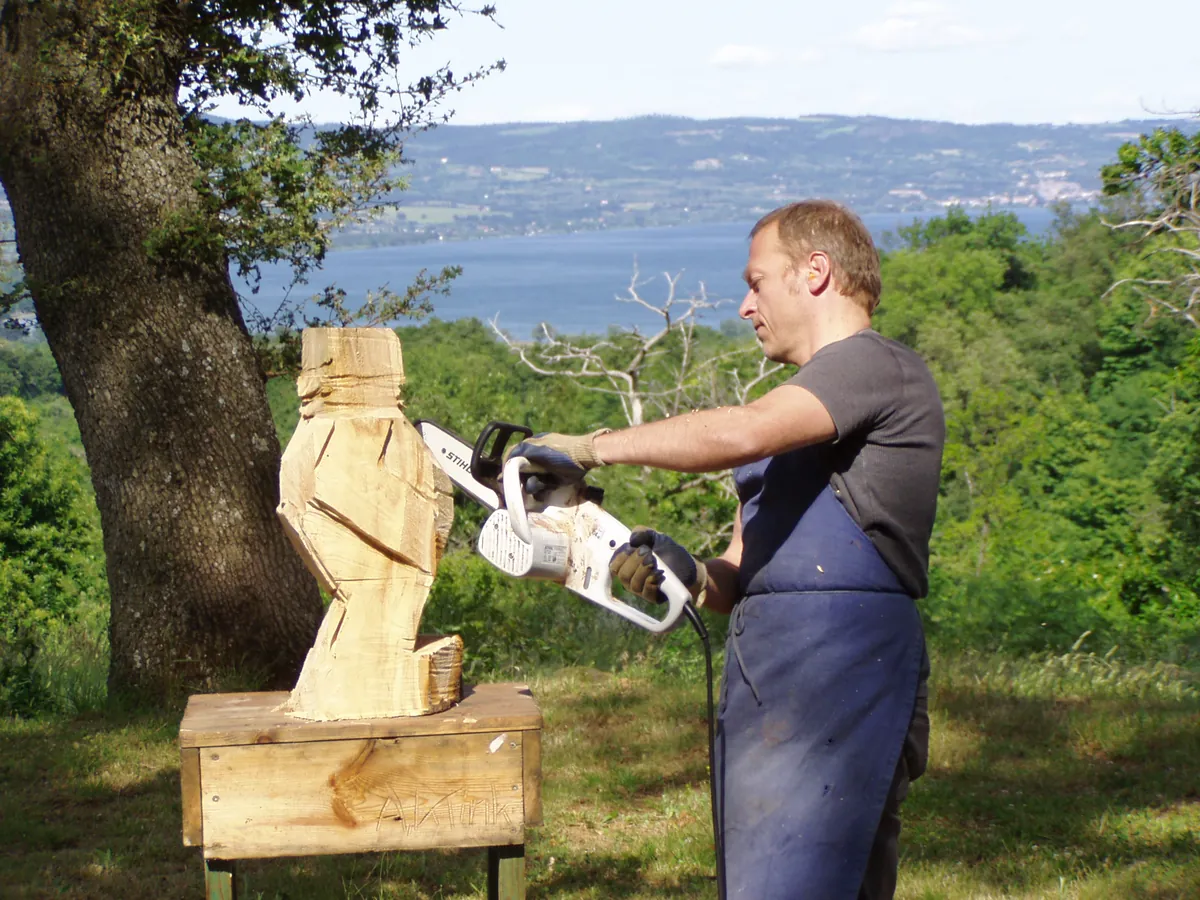
For several years I ran sculpture workshops as a small summer academy at Lake Bolsena in northern Lazio. Two cedar wood sculptures about three and a half metres high were made there, one at the entrance to Montefiascone and one down by the lake.
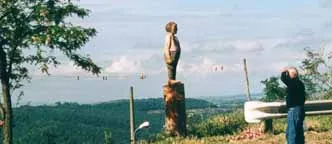
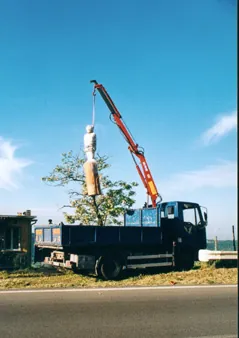
During that time an olive grove was being renewed and old olive trees were felled. That allowed me to buy about two tons of olive wood. So that this was manageable for me and the wood could be seasoned in the meantime, I found a place with a farmer whose family has lived and worked on the hillside directly above the lake for generations. There I was able to store the wood for one or two years.
It may be that my command of the language did not make things easier. But it was plain to see that the farming family were puzzled about what a German wanted with this old olive wood.
On my next visit in the spring I brought them a sculpture made from that wood. It gave them great pleasure. They were proud to be part of the whole, and they recognised in the sculpture their own connection with the wood and where it came from.
Oak, black locust and wood from private gardens
I love oak and black locust, precisely because they stand up so well to the weather.
People come to me again and again bringing wood from their garden. They would like a sculpture made from it. That is a particular challenge, because as a rule they are emotionally attached to that piece of wood. Perhaps their grandfather planted the tree. Perhaps they grew up under it themselves. And suddenly only a single piece of that tree is left.
In this form the wood cannot be replaced. That is exactly why it is a great challenge for me, and one I gladly accept. If the piece is too large and therefore stays in the garden, I have been happy to work on it there.
Wood as a witness
There are woods that carry something into my work through the historic place they come from, almost as witnesses.
A number of lime trees that had to be removed in connection with the extension of the Berlin underground line U5 from Alexanderplatz towards the Bundestag, and later the central station, were made available to me. Wood from the inner courtyard of a former SS administration building in Berlin-Steglitz and from a barracks in Berlin-Tegel has also gone into my work.
Two very large pieces of lime came to me from Görlitzer Strasse, close to the former Görlitzer railway station. Out of one of them I cut a double sculpture. Deep inside the wood an old rusted nail appeared and blunted my carving blade. The nail ran straight through the arm of the sculpture.
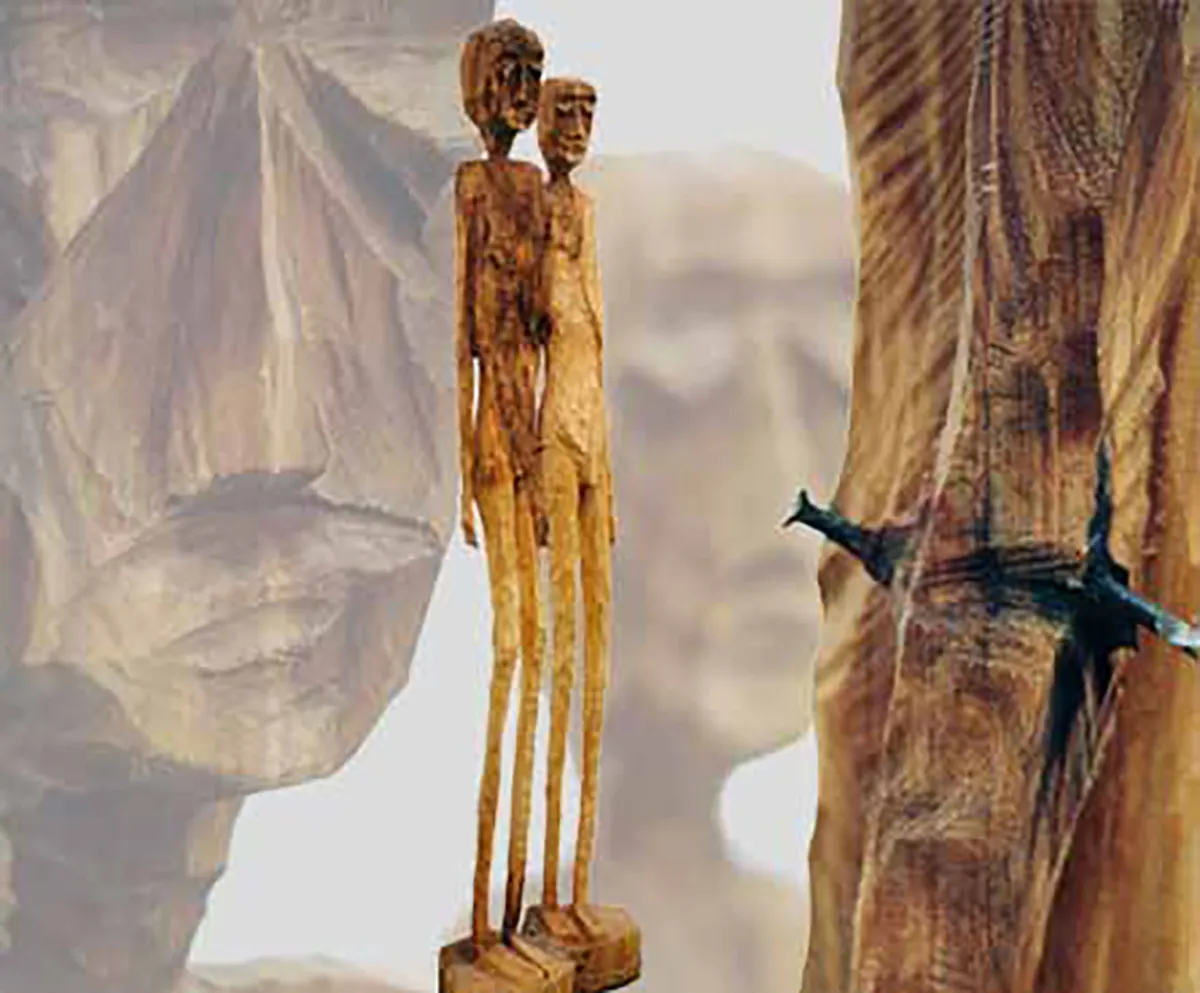
So I did not remove it, I took it into the sculpture. Judging by the state of the metal it had probably been driven in during the post-war years. Perhaps it held a poster or a washing line. The sculpture is now called a pierced man and the Friend and has found a home in an old cottage in Ireland.
A small gilded lion figure was also made from a large piece of this lime wood from Görlitzer Strasse. The whole surface of the trunk is for me like a savannah in which the lion circles. And somewhere in that landscape there is a charred, burnt structure with a metal core, probably part of a shell from the last, unspeakable battle for Berlin. In this way the wood itself becomes a carrier of history.
Storm wood from Berlin
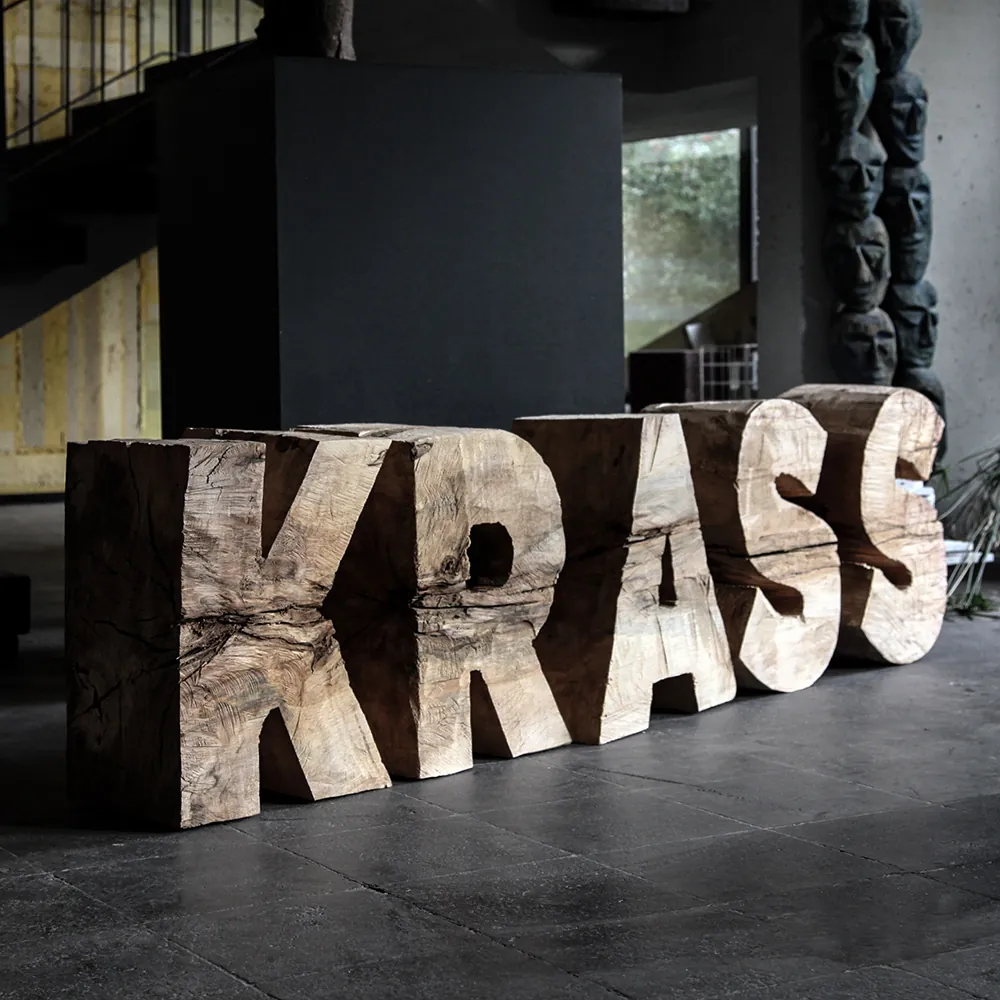
In 2007 the destructive storm Kyrill swept across Berlin. The parks department of Charlottenburg then made several of the fallen trees available for my sculptural work.
From a trunk about 80 centimetres thick, whose core was no longer entirely sound, came a work in which that very structure was what interested me. Out of the trunk I carved the large letters KRASS.
A large, thick, fully grown oak had also come down in the storm. I cut the trunk to a length of about 1.60 metres, stood it up and carved an astronaut some 15 centimetres tall out of the top. He stands at eye level in front of me.
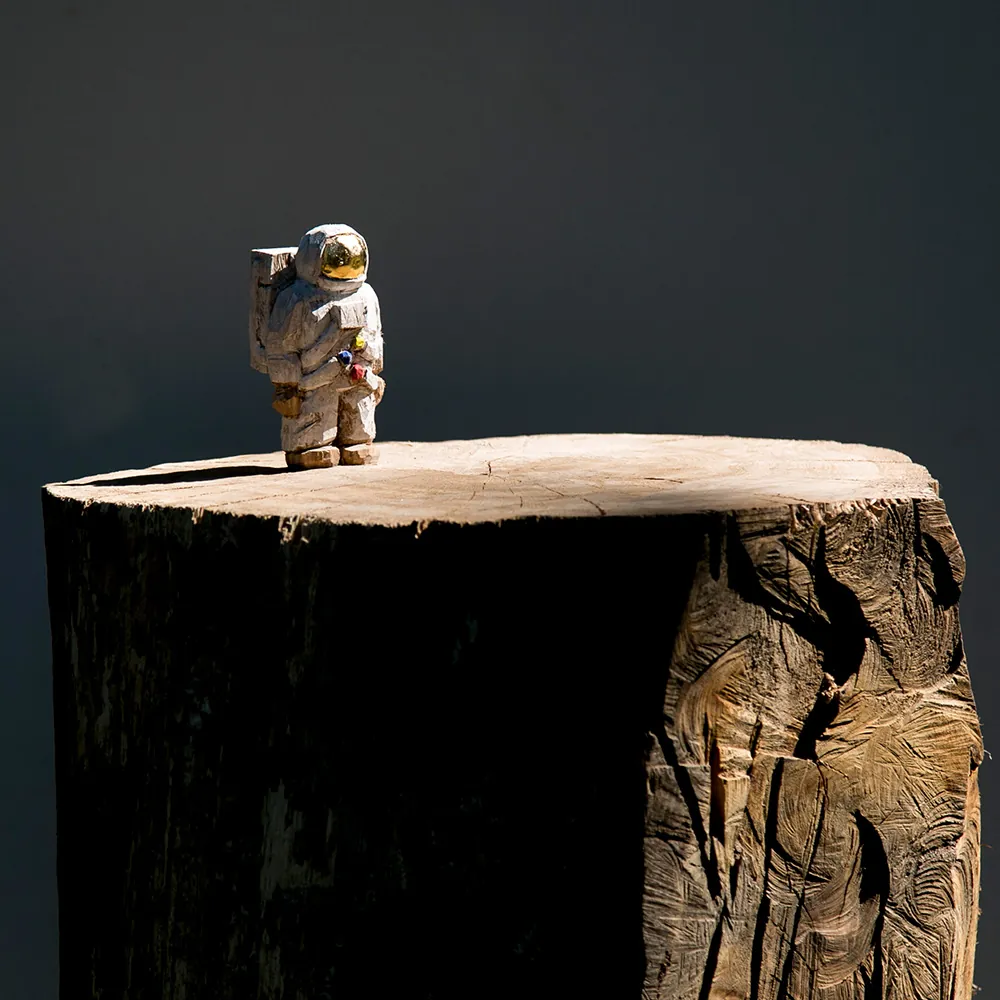
At first I only see the surface of the cross-section of the tree and the small astronaut, as if he were on the moon. As I step further back I see what he is standing on: the enormous oak trunk as an image of the earth.
That is part of my way of looking at the icon of the astronaut, or the cosmonaut, of the 1970s, and it belongs with my group of astronaut sculptures.
When sculpture and trunk come from one piece
I also like working with smaller pieces of wood in which the sculptures stand directly. The shoulders can still be almost surrounded by the bark. The grain, the annual rings and the core of the wood then form, almost intuitively, a backbone, a centre within the sculpture.
That is one of the reasons why I like to form figure and trunk from a single piece of wood. You notice at once, quite unconsciously and without reflecting on it, that the sculpture came out of this trunk and is connected with it.
The lower part is then not simply a plinth. It is part of the whole. When a sculpture stands on a trunk 1.50 metres long, that trunk is part of what the sculpture says, and not just a base to make the figure easier to see.
For me it is a wonderful challenge not to use lime, the typical carving wood, even though it cuts so easily.
Wood from the Hoher Fläming
One of my good neighbours at my studio in the Hoher Fläming keeps inviting me to visit his old farm. Each time that farm is a journey back in time for me, into a period long since overtaken.
At the back of the yard stood an enormous rose bush. At some point it had to be cut back hard because it had grown too large. Small rosewood trunks were left.
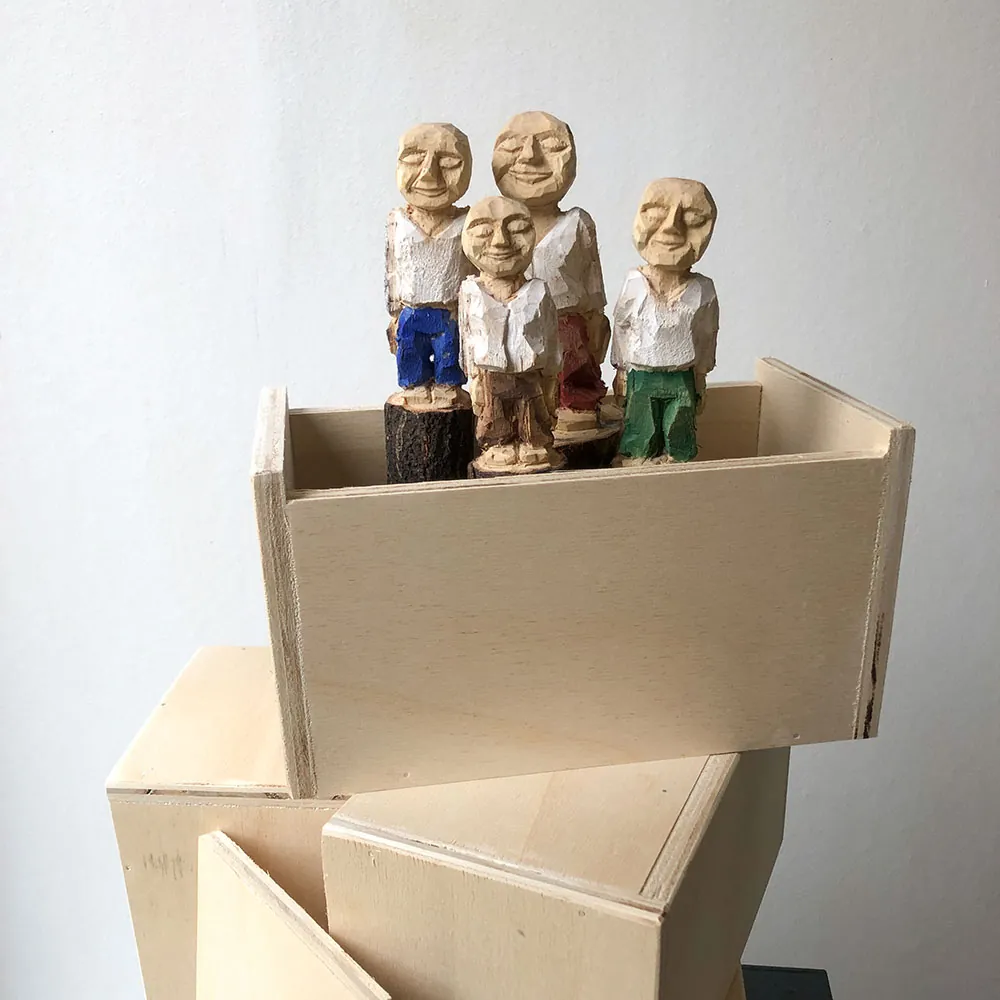
Out of them I made a whole series of small sculptures: die Freunde von Werner, Werner's friends. A small group stands in Rottweil today, individual pieces have found homes in various parts of Germany. There was lilac wood on the farm as well. The trunks had grown large enough to make sculptures from.
When I was looking for new wood, a good birch or a maple, my neighbour from the Fläming was always ready to set off with me in his Opel Astra. We drove along field tracks that at some point turned into forest tracks. The rest of the way we had to walk. These were woods that had been expropriated from his family for many years and were only returned to him well after reunification.
Then he walked through the forest with me. I was allowed to choose the right wood myself, by place, position and growth. Those are the things I am allowed to decide. What do I take? What do I leave standing? How do I deal with wood that has grown? Not brutally, but attentively. I am very grateful for this opportunity and for these experiences.
Human Space
One of my first larger groups of sculptures, Human Space, with 51 stele-like pieces between about 1.10 and 1.30 metres high, was made during a longer stay in the Allgäu and at Lake Constance.
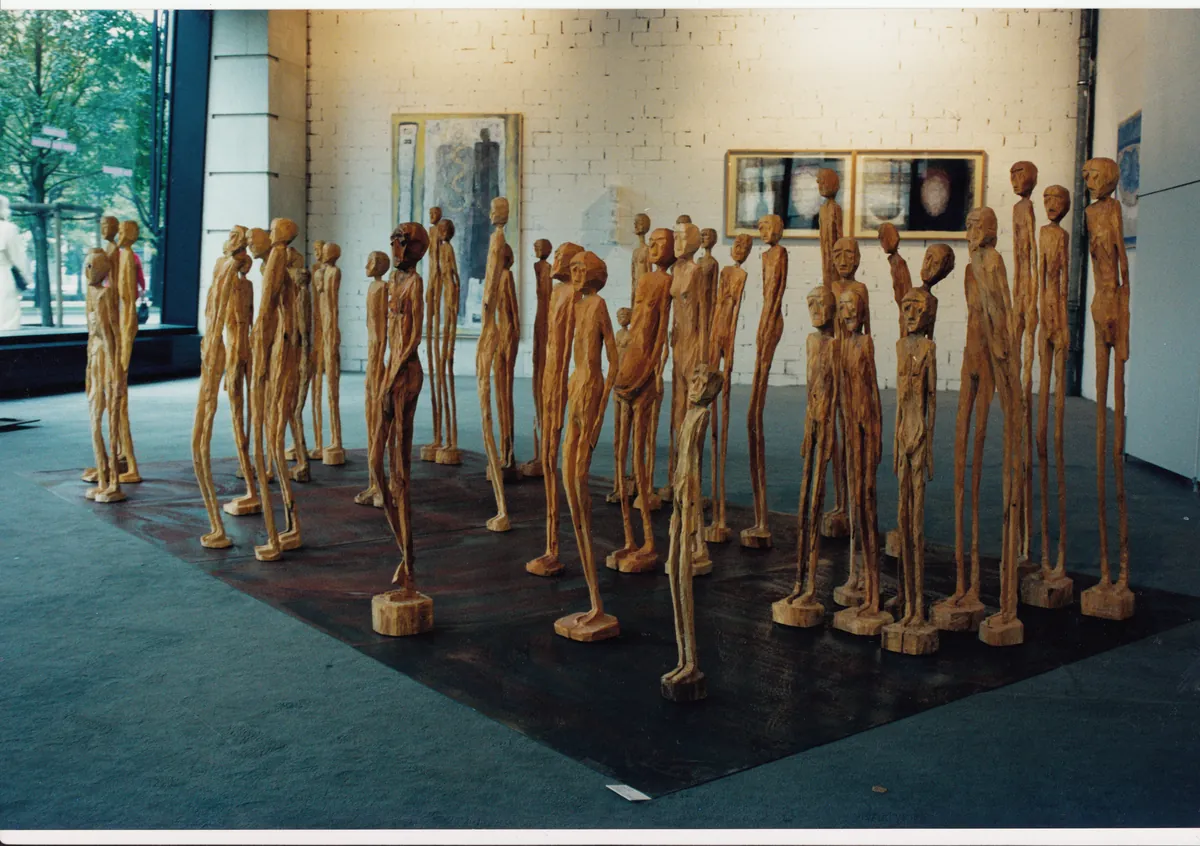
The whole work is a mixture of woods from mixed forest. Thicker branches and smaller trunks, rarely more than ten to fifteen centimetres across, of beech, maple and oak, were given to me by farmers and by people from the villages there.
Here too the wood was not simply a material I bought and then worked. It came out of a landscape, out of particular hands and out of a particular place.
Felix Krone and Franziska Krone
A good many of my works are at home in the Havel region. The building authority of the municipality of Schwielowsee probably noticed this and asked me to work on an oak at Baumgartenbrück, by the large bridge towards Werder, which sadly had to be felled.
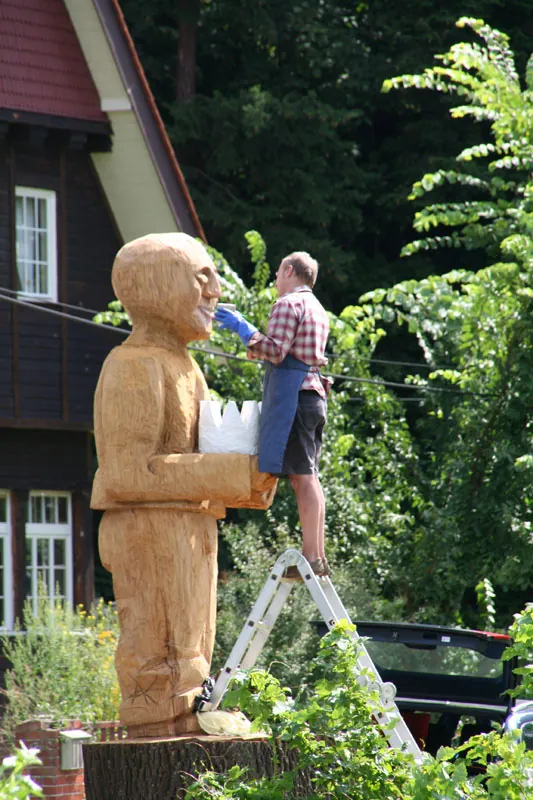
Right at the shore I worked out Felix Krone. He stands there almost four metres high and looks out over the lake. Looking is relative, of course, because his eyes are closed. In his hand he holds a very large crown, which he offers as a gift to the people passing by in their boats. Obligingly, with a little skill you can climb up the sculpture. You can crouch down in front of him, and he places that far too large crown on your head.
A few years later a second oak was added a few metres further along. Franziska Krone came out of it. She looks out over the lake with a confident air, hands in her pockets, just like Felix Krone. Her crown, though, stands in front of her like a wheel. She holds one foot on it.
In this sculpture too the traces of the inhuman fighting of the Second World War were visible. At shoulder height there was a shell splinter about three centimetres across, completely grown over by the wood. Over an area of some 20 centimetres the wood was charred. So many years later these traces were still there.
The two Krone sculptures stand in front of the Baumgartenbrück inn, by the landing stage at the crossing towards Werder.
What wood am I made of?
In general, wood with character means for me wood with a history. The image that comes out of this wood is for me always bound up with that history.
There is a German saying: what wood am I carved from? For me it takes on a particular meaning. Of course I can develop my personality. But I also have to recognise what wood I am made of.
Which history? Which imprints? Which basic conditions determine my existence? And what can I make of them?
If it is possible to bring these things into accord with one another, then for me an inner beauty arises. A beauty that does not rest on flawlessness and not on a standard expected from outside. Beauty then means something else. Perhaps what Joseph Beuys once called the splendour of truth.
The woods at a glance
Among the woods in Albrecht Klink's work are lime from Görlitzer Strasse in Berlin-Kreuzberg and from the U5 underground construction site, oak and poplar from the storm wood of the Kyrill hurricane, olive wood from northern Lazio, cedar from Montefiascone, black locust, rosewood and lilac from the Hoher Fläming, and beech, maple and birch from the mixed forest at Lake Constance and in the Allgäu.
Places this wood comes from, or where works made from it stand: Berlin, Görlitzer Strasse, Berlin-Steglitz, Berlin-Tegel, Berlin-Charlottenburg, Alexanderplatz, Hoher Fläming, Baumgartenbrück, Schwielowsee, Werder an der Havel, Rottweil, the Allgäu, Lake Constance, Lake Bolsena, Montefiascone and Lazio.
Further in the work
- Selected WorksThe work arranged by theme: wood sculpture, The Crown, astronauts, Letter Works, wooden newspapers and photography on wood.
- Current WorkThe pieces currently in the studio and in the showroom.
- BiographyThe path from Weil am Rhein by way of Italy and northern Norway to Berlin and the Hoher Fläming.
- Wilhelm Klink, the grandfatherSculptor, painter and local historian in Horb am Neckar, 1874 to 1952.